In the previous articles, we described the cloud architecture that will be built for this Ironman competition. Starting today, we will introduce the IaaS layer used: OpenStack. This article will begin with an overview, and subsequent posts will provide detailed introductions to each OpenStack component.
Table of Contents
Reference
This series of articles will make extensive use of OpenStack's own documentation as references and image sources.
To learn more about OpenStack concepts, you canthe official documentationread directly
What is OpenStack?
To discuss what OpenStack is, we can look at it from three perspectives:
- Software
- Community
- Group
Software
OpenStack is essentially a software suite capable of providing private and public cloud services, covering various use cases such as general enterprises, telecommunications providers, and high-performance computing (HPC).
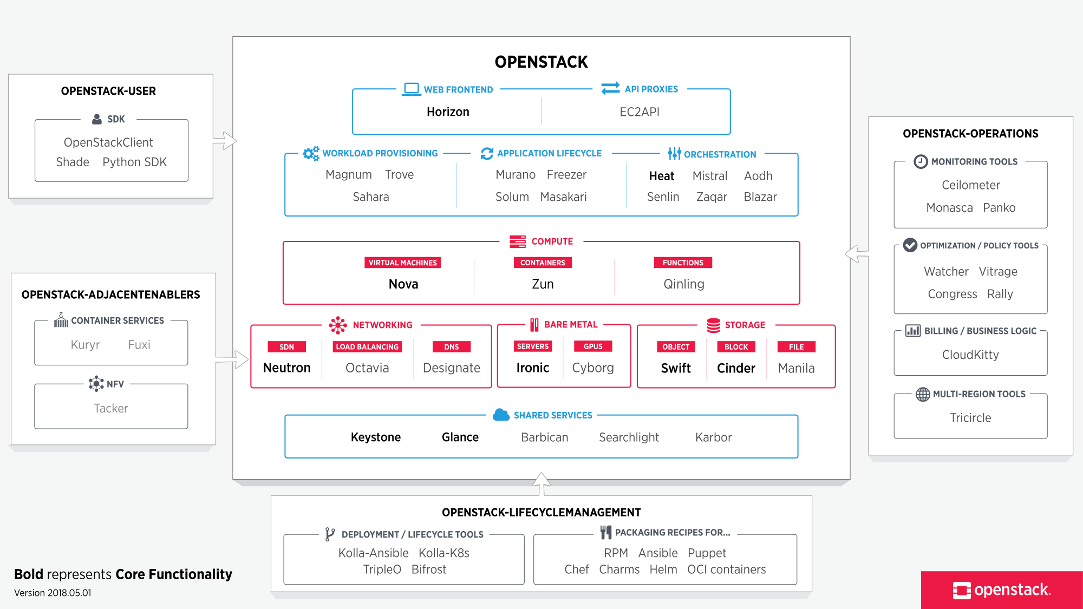
From a software perspective, OpenStack is composed of multiple microservices, which users can combine according to their application scenarios to meet their needs. These services are primarily provided via REST APIs, and Software Development Kits (SDKs) for various programming languages are also available to access them.
This software can be installed using the official tarballs; furthermore, pre-packaged versions are available in the package managers of major Linux distributions.
OpenStack Software Map:
Community
Beyond the software, OpenStack is also a massive community, and the goal of this community is:
To create a ubiquitous open-source cloud computing platform that is easy to use, easy to implement, interoperable across deployments, and scalable to any size, while meeting the needs of both public and private cloud users and operators.
OpenStack provides an ecosystem for collaboration, which includes the following infrastructure:
- Code Review
- Testing
- CI
- Version Control
- Documentation
- A suite of collaboration tools, including wikis, IRC channels, Etherpad, and Ethercalc.
The Four Opens
The fundamental principles of the OpenStack community are the "Four Opens."
- Open Source
- Open Design
- Open Development
- Open Community
Groups
Additionally, many people form various groups within the community, where each group discusses and contributes based on a primary area of focus; we call these SIGs (Special Interest Groups).
Summary
In this article, the author introduces OpenStack from a more non-technical perspective. Starting from the next article, we will take a technical approach to introduce the components of OpenStack, their functions, and how they work together.
Reference
Copyright Notice: All articles in this blog are licensed under CC BY-NC-SA 4.0 unless otherwise stated.

